CONCEPT EXPLAINER · 1:20
Call Options — Concept Explainer Video
Open the MP4 video · Optional English captions are available in the player.
A call option gives its buyer the right to buy an underlying asset at a fixed strike price, subject to the contract rules. Think of it as reserving a purchase price for a limited time.
Related videos
Browse all videos →
Transcript
A right to buy
A call option gives its buyer the right to buy an underlying asset at a fixed strike price, subject to the contract rules. Think of it as reserving a purchase price for a limited time.
Strike and premium are different
Suppose a stock is one hundred dollars. You buy a one hundred dollar call expiring next month for four dollars per share. With a standard one hundred share multiplier, the option costs four hundred dollars before fees.
Value is not the same as profit
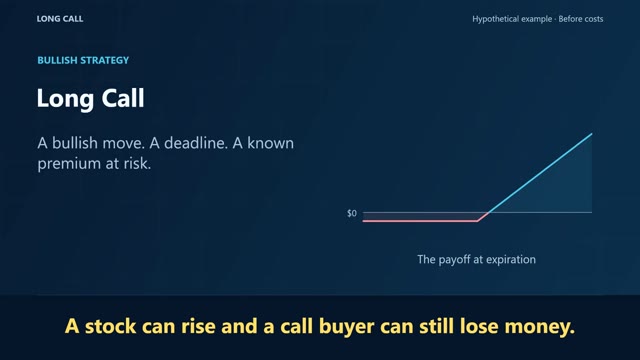
At expiration, a stock price of one hundred ten dollars gives the call ten dollars of intrinsic value per share. Subtract the four dollar premium: profit is six dollars per share, or six hundred dollars before costs.
The clock matters
If the stock finishes at or below the strike, the call has no intrinsic value and the premium is lost. Before expiration, time and implied volatility also affect its resale price. A rising stock does not guarantee a profitable call.
Keep the two sides separate
The buyer has a right. A call seller takes an obligation, and an uncovered stock call can have unlimited loss. Remember the three numbers: strike, premium, and expiration. Together, they describe the deal you are making.
Video credits
Narration: AI-generated voice (Cedar).
Music: "Space Jazz" by Kevin MacLeod (incompetech.com)
Source: https://incompetech.com/music/royalty-free/index.html?isrc=USUAN2100030
Licensed under Creative Commons Attribution 4.0: https://creativecommons.org/licenses/by/4.0/
Changes: excerpted or looped, equalized, lowered beneath narration, faded in and out.