CONCEPT EXPLAINER · 1:17
Put Options — Concept Explainer Video
Open the MP4 video · Optional English captions are available in the player.
A put gives its buyer the right to sell an underlying asset at the strike price, subject to the contract rules. It can express a bearish view or help protect shares already owned. The protection itself costs a premium.
Related videos
Browse all videos →
Transcript
A right to sell
A put gives its buyer the right to sell an underlying asset at the strike price, subject to the contract rules. It can express a bearish view or help protect shares already owned. The protection itself costs a premium.
A simple contract
Imagine a stock at one hundred dollars. A one hundred dollar put expiring next month costs three dollars per share. For a standard one hundred share contract, you pay three hundred dollars before fees.
When the stock falls
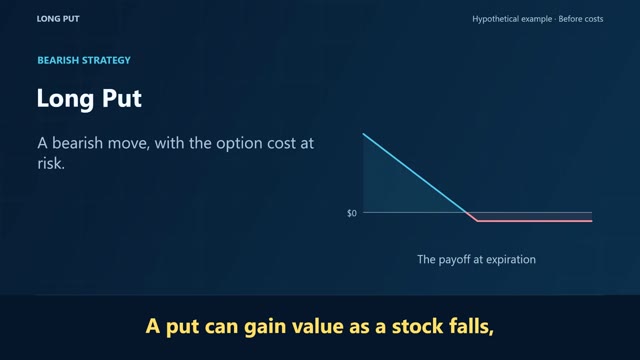
At expiration with the stock at ninety dollars, the put has ten dollars of intrinsic value per share. Subtract the three dollar premium, and the standalone put has a seven hundred dollar profit before costs.
Protection and speculation differ
If the stock finishes at or above one hundred, the put has no intrinsic value. A protective put must be assessed together with the shares: a gain on the put may offset a stock loss, rather than create a portfolio profit.
A right versus an obligation
The standalone buyer can lose the premium paid. A put seller may have to buy shares at the strike, even after a large decline. Track the option and any resulting share position separately, because exercise changes what you own.
Video credits
Narration: AI-generated voice (Cedar).
Music: "Tiki Bar Mixer" by Kevin MacLeod (incompetech.com)
Source: https://incompetech.com/music/royalty-free/index.html?isrc=USUAN2000006
Licensed under Creative Commons Attribution 4.0: https://creativecommons.org/licenses/by/4.0/
Changes: excerpted or looped, equalized, lowered beneath narration, faded in and out.